
Bitcoin Faces Significant Monthly Decline
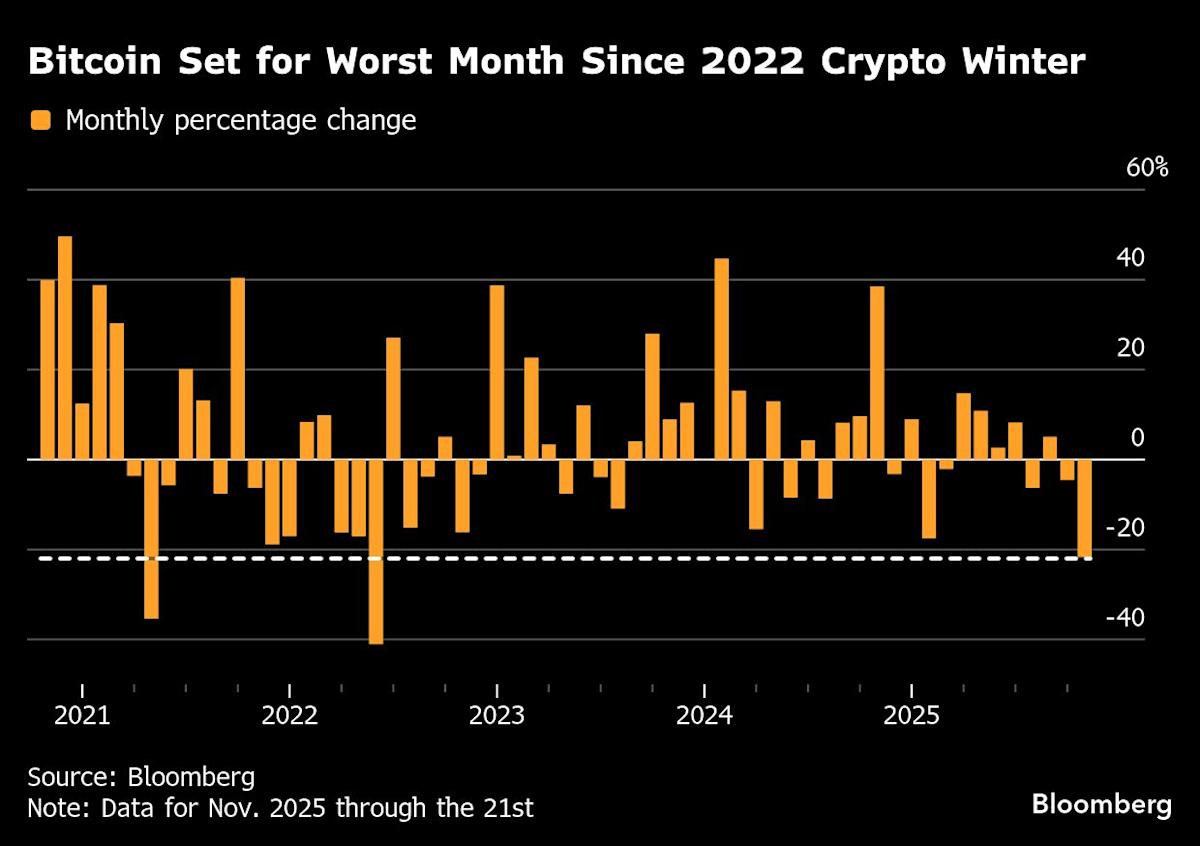
Bitcoin is on course to record its most substantial monthly decline since a series of corporate failures shook the cryptocurrency landscape in 2022. The leading cryptocurrency experienced a drop of up to 7.6%, reaching a low of $80,553, before recovering slightly on Friday. Meanwhile, Ethereum, the second-largest cryptocurrency, plunged as much as 8.9%, dipping below the $2,700 mark, with many smaller digital currencies also experiencing similar downturns. According to data from CoinGecko, the overall market capitalization of cryptocurrencies has fallen below $3 trillion for the first time since April.
Monthly Losses Highlight Market Instability
In November alone, Bitcoin has lost approximately 25% of its value, marking the steepest decline for any month since June 2022, as reported by Bloomberg. This tumultuous period was initiated by the collapse of Do Kwon’s TerraUSD stablecoin in May 2022, which set off a chain reaction of failures culminating in the collapse of Sam Bankman-Fried’s FTX exchange. Despite a pro-cryptocurrency stance from the White House during Donald Trump’s presidency and increased institutional interest, Bitcoin has seen a drop of over 30% since its peak in early October.
Market Volatility Driven by Liquidations
The recent downturn has been exacerbated by a significant wave of liquidations that occurred on October 10, resulting in $19 billion in leveraged token positions being wiped out, which in turn led to a loss of approximately $1.5 trillion in the total market value of cryptocurrencies. Chris Newhouse, the director of research at Ergonia, a firm focused on decentralized finance, noted, “The combination of forced liquidations and systemic ETF selling has left the market in a particularly fragile condition, making any stabilization efforts immediately countered by supply from various sources.”
Escalating Selling Pressure
In the past 24 hours, the selling pressure has further intensified, with an additional $2 billion in leveraged positions liquidated, as reported by CoinGlass. The broader market conditions have not provided any relief; US stocks, which initially surged on renewed interest in artificial intelligence following positive earnings reports from Nvidia Corp., lost momentum late Thursday due to concerns over inflated valuations and uncertainty regarding a potential Federal Reserve rate cut in December. Stock prices continued to fluctuate on Friday amid this uncertainty.
Market Sentiment at an All-Time Low
Investor sentiment has plummeted, with indications of “extreme fear” permeating the market based on a sentiment gauge that accounts for volatility, momentum, and demand. This index, compiled by Coinglass, has reached its lowest point since the 2022 downturn, hovering around 94, a stark contrast to the heightened optimism seen shortly after Trump’s presidential victory a little over a year ago.
Institutional Reluctance to Enter the Market
Institutions appear hesitant to capitalize on the current market weakness. A group of 12 Bitcoin exchange-traded funds (ETFs) listed in the US experienced net outflows totaling $903 million on Thursday, marking their second-largest redemption day since their launch in January 2024. Additionally, open interest in perpetual futures has dropped by 35% from its peak of $94 billion in October.
Concerns About Bitcoin Hoarding Strategies
Tony Sycamore, an analyst at IG Australia, suggested that the market might be testing the resilience of certain strategies, specifically referencing Michael Saylor’s original Bitcoin hoarding approach. The market capitalization to Bitcoin holdings ratio for Strategy Inc. has plummeted to just above 1.2. Analysts from JPMorgan Chase & Co. have raised alarms that Strategy may risk losing its place in significant benchmarks such as the MSCI USA and Nasdaq 100, with a decision expected by January 15.
Pressure on Copycat Strategies
Companies that attempted to mirror Saylor’s Bitcoin accumulation strategy this year are also feeling the strain. Firms like Sequans Communications, ETHZilla, and FG Nexus have started liquidating some of their positions to finance stock buybacks aimed at bolstering their declining share prices. On Friday, Bitcoin recorded its 11th consecutive lower low, marking the longest such streak since 2010, according to Bloomberg data analysis.
Overall Market Risk and De-risking Trends
Bohan Jiang, a senior derivatives trader at FalconX, commented on the prevailing market climate, stating, “We’ve observed many participants in the crypto space experiencing considerable losses, leading to a marked decrease in risk-taking across the board, as many are focused on de-risking their positions among major and altcoins to safeguard their year-end results.”


